do: SANTA CUEVA DE COVADONGA, ESPANHA

12.3.13


Dois sossegados leões tomam conta do santuário dedicado á Virgem da Covadonga. A Santa Cueva é um lugar de passagem obrigatória para quem entra nos Picos da Europa via Cangas de Onís. No post anterior já tinha contado um pouco da história deste lugar em que muitos acreditam que foi graças á Virgem que Pelágio pode vencer os muçulmanos e dar inicio á Reconquista da Península Ibérica.

Hoje podemos ver o seu túmulo na Santa Cueva e junto a ele a imagen da Virgem.


Two quiet lions take over the shrine dedicated to the Virgin of Covadonga. The Santa Cueva is a place of obligatory passage for those entering in the Picos de Europa via Cangas de Onis. In the previous post I had already told some of the history of this place that many believe was thanks to the Virgin that Pelagius could defeat the Muslims and started the Reconquest of the Iberian Peninsula.
Today we can see his tomb in Santa Cueva and close to him the image of the Virgin.


Foi outro rei Astúriano que mandou construir este Santuário na mesma gruta onde dizem que Pelágio se refugiou durante as batalhas contra os mouro, o seu neto D. Afonso I (século VIII). Mas foi o Rei Afonso X (século XIII) de Castela que fez com que o túmulo do primeiro rei asturiano ficasse neste local que consideram sagrado e que é hoje zona de peregrinação. Uma placa assinala a visita do seu peregrino mais famoso, o Papa João Paulo II.

Dizem que Covadonga significa fonte da cova e é verdade que por baixo da gruta podemos ver uma pequena queda de água e um lago.

Another asturian king who built this temple in the same cave where they say Pelagius took refuge during his battles against the Moor, his grandson D. Alfonso I (eighth century). But it was King Alfonso X (XIII century) of Castile that made the tomb of the first king Asturian stay in this place that they consider sacred and what is now the area of pilgrimage. A plaque marks the visit of his most famous pilgrim Pope John Paul II.
They say that Covadonga means fountain of the cave and it is true that beneath it we can see a small waterfall and a lake.


Website: http://www.santuariodecovadonga.com/

do: BASÍLICA DE SANTA MARIA LA REAL- COVADONGA, ESPANHA

11.3.13


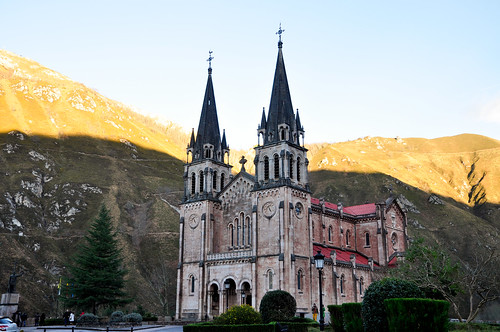
Quinze minutos separavam Cangas de Onís da Covadonga onde chegámos á Basílica de Santa Maria La Real. Aos poucos e enquanto disfrutávamos do sinuoso caminho para lá chegar, ela ia revelando a sua forma.

Não sabia muito sobre este lugar, sabia que é dos mais importantes da história das Astúrias mas faltava o porquê. A estátua em bronze do rei Pelágio (Pelayo) das Astúrias começou a desvendar o mistério que ia na minha cabeça, foi daqui que ele defendeu o seu reino da invasão muçulmana e foi em Cangas que morreu.


Fifteen minutes separated Cangas de Onis from Covadonga where we arrived at the Basilica of Santa Maria La Real. While we were enjoying the view of the winding road to get there, it was revealing it's shape.
I didn't know much about this place, you know that is the most important in the history of Asturias but I missed the reason why. The bronze statue of King Pelagius (Pelayo) of Asturias began to unravel the mystery that was in my head, it was here that he defended his kingdom from the Muslim invasión and it was in Cangas where he died.


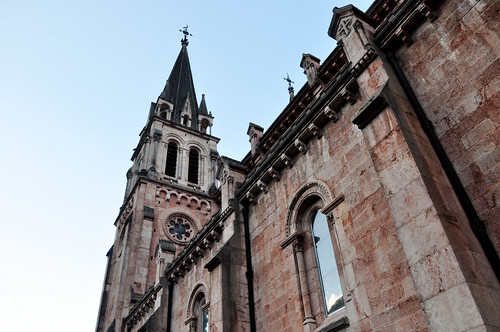
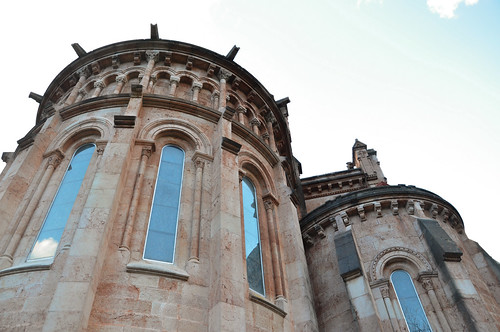
Mas a basílica que vemos hoje não é obviamente do seu tempo, nem foi a primeira a marcar o seu lugar aqui nos Picos da Europa. Foi construída no final do século XIX de estilo neoromânico.

A visita é gratuita e não é permitido tirar fotos que na realidade seria complicado ter boas porque no seu interior havia pouca luz. Composto por três naves, o seu interior é simples sem grandes pontos de relevância além das habituais imagens de santos, da Nossa Senhora, etc..

Para mim o importante da visita não foi a Basílica mas sim o lugar em si, a vista que proporcionava e o seu significado. Dizem que ao lutar contra os muçulmanos a Virgem de Covadonga fez soltar umas pedras na montanha que permitiu a vitória do exército liderado por Pelágio e aqui começa a Reconquista.


But the basilica we see today is obviously not from his time, nor was the first to mark it's place here in the Picos de Europa. It was built in the late nineteenth century with a neoromanesque style.
The visit is free and pictures inside are not allowed that would be really complicated to have a good photo inside because there was little light. Comprised of three ships, the interior is simple with no major points of relevance beyond the usual images of saints, the Virgin Mary, etc. ..
For me the important thing was not to visit the Basilica but the place itself, the view it provided and its meaning. They say that when fighting the Muslims, the Virgin of Covadonga made some rocks drop on the mountain that allowed the victory of the army led by Pelagius and here began the Reconquista.


do: PRAÇA DE CIBELES - MADRID, ESPANHA

10.3.13


Esta é mais emblemática praça da cidade de Madrid, é para ela que se dirigem os madrilenhos quando querem celebrar ou por ela passam quando se querem manifestar contra o governo.

É também das mais famosas fora de Espanha graças a todas as celebrações ligadas ao mundo do futebol com as vitórias nos Campeonatos Europeus e no Mundial levam uma multidão á sua fonte no centro. Também para um dos clubes da cidade ela é o local de celebração, o ano passado os vencedores do Campeonato Espanhol, o Real Madrid vieram aqui festejar mais um título que culminou com um Iker Casillas a colocar um cachecol á volta do pescoço da deusa Cibeles.


This is most emblematic square of Madrid, to it "madrileños" go when they want to celebrate or pass by it when they want to speak out against the government.
It is also the most famous outside Spain thanks to all the celebrations connected with the world of football with victories in the European Championships and the World Cup bring a crowd to its source in the center. Also for one of the clubs in the city it is the place of celebration, last year the winners of La Liga, Real Madrid came here to celebrate another title that culminated with Iker Casillas placing a club's scarf around the neck of the goddess Cibeles.


É a sua fonte dedicada á deusa da fertilidade que lhe dá parte da fama e do brilhantismo, está sentada na sua quadriga puxada por dois leões. Foi desenhada por Ventura Rodríguez no século XVIII durante o reinado de Carlos III.

Á sua volta dois emblemáticos edificios de Madrid, um é o Palácio de Cibeles ou o antigo Palácio das Comunicações. A sede do "ayuntamiento" de Madrid é hoje uma das suas maiores zonas culturais conhecida como o Centro Centro.

E o outro, o Banco de Espanha esta a caminho da Gran Vía, foi construido no século XIX e a sua fachada principal dá para a praça.


It is the fountain dedicated to the goddess of fertility that gives part of it's fame and brilliance, she is sitting in her chariot pulled by two lions. It was designed by Ventura Rodriguez in the eighteenth century during the reign of Carlos III.
Around it two emblematic buildings of Madrid, one is the Cibeles Palace or the old Palace of Communications. The headquarters of the city's "ayuntamiento" (town hall) is now one of its largest cultural zones known as the Centro Centro.
And the other, the Bank of Spain is on the path to Gran Vía, was built in the nineteenth century and its main facade overlooks the plaza.


View from the belvedere of the Centro Centro


View from the belvedere of the Centro Centro


Metro: Banco España

View Larger Map

do: THYSSEN-BORNEMISZA - MADRID, ESPANHA

8.3.13


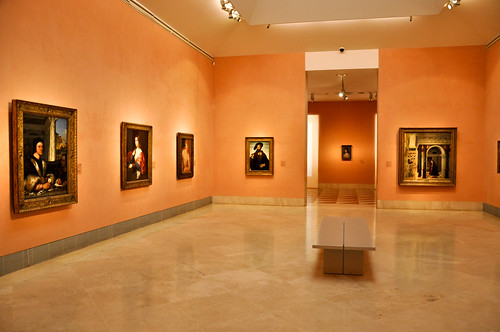
Duas curiosidades: a primeira é que este era o museu que nos faltava para completar o famoso triângulo da Arte, a segunda é que os anteriores visitei antes de viver em Madrid o que significa que tive três anos sem completar esse mesmo triângulo.

E se me perguntam de qual gostei mais não conseguiría responder, mas se só tens um dia em Madrid e tens que escolher um eu talvez deixasse este para último. O Prado tem pintores espanhóis dos séculos XVII e XVIII (como Goya e Velázquez) e o Reina Sofia tem mais modernos como Picasso (com o seu famoso "Guernica"), Dali e Miró.


Two curiosities: the first is that this was the museum that we needed to visit to complete the famous Art Triangle, the second is that the others I visited before living in Madrid which means that Ithree years without completing that same triangle.
And if you ask me which one I liked most I could not answer, but if you only have one day in Madrid and you have to choose one I might leave this one to last. The Prado has Spanish painters of the seventeenth and eighteenth centuries (as Goya and Velázquez) and the Reina Sofia has more modern as Picasso (with its famous "Guernica"), Dali and Miró.


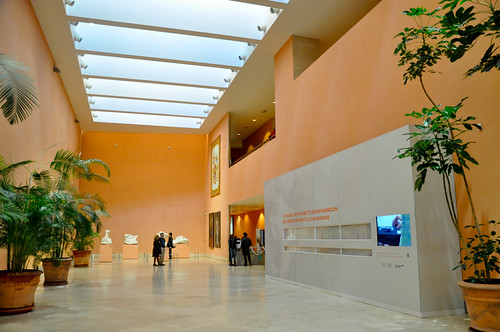
No fundo são mais representativos da arte espanhola nas suas épocas douradas enquanto o Thyssen na sua exposição permanente pode ser mais apelativo para conhecer pintores estrangeiros como Van Gogh, Mondrian, Kandisky entre outros. É bastante completo cubrindo várias épocas da pintura desde o renascimento e a arte sacra, passando por Caravaggio e Rubens, pelo barroco e impresionismo, pelo cubismo e o abstracto do século XX.

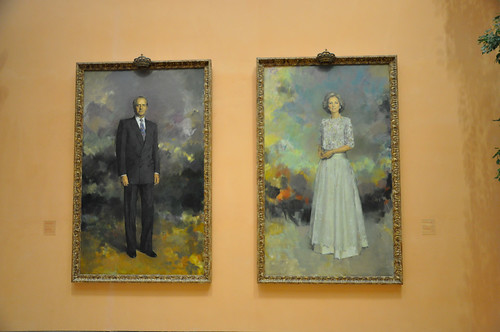
A dar as boas vindas estão dois grandes retratos dos actuais reis espanhóis: Juan Carlos e Sofia.


At the end they are the most representative of Spanish art in its golden ages while Thyssen in their permanent exhibition may be more appealing to learn about foreign painters like Van Gogh, Mondrian, Kandinsky, among others. It is fairly complete covering various eras of painting since the Renaissance and religious art, through Caravaggio and Rubens, Baroque and impressionism, cubism and abstract of the twentieth century.
To welcome you there are two large portraits of current Spanish kings: Juan Carlos and Sofia.


Nós cometemos alguns erros amadores, não olhámos bem para o mapa e começámos no piso 0 que era exactamente o fim, nem podemos dar a desculpa de que o guia não estava em português.

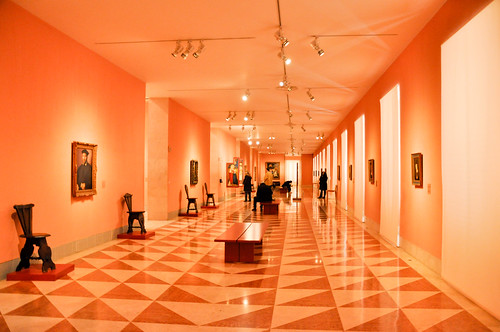
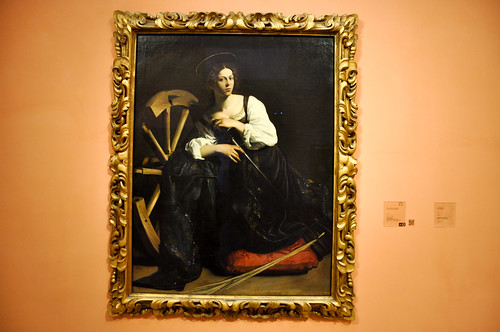
O correcto será começar no segundo andar e ir descendo. Nesse piso está a arte medieval, a pintura italiana, flamenga e é onde podemos encontrar pintores como Caravaggio, El Greco, Tiziano, etc..

We made ​​some amateurs mistakes, we didn't look at the map so we started on level 0 that was exactly the last one, and we can't even give the excuse that the guide was not in Portuguese.
The proper thing is to begin on the second floor and go down. In that floor there is the medieval art, painting Italian, Flemish and this is where we can find painters like Caravaggio, El Greco, Titian, etc...


Santa Catarina de Alexandria - Caravaggio


No primeiro andar está a pintura holandesa, pinturas retratando a natureza morta. Devo admitir que não foi a minha zona preferida. Veio depois uma zona do Romantismo ao Realismo com bastantes retratos e paisagens.

No final encontramos o Impressionismo onde estão quadros de Van Gogh, Renoir, Monet, Degas, etc..


On the first floor there's Dutch painting, still life paintings. I must admit it was not my favorite zone. Then came a área of Romanticism to Realism with many portraits and landscapes.
In the end we foun Impressionism with paintings of Van Gogh, Renoir, Monet, Degas, etc..
Related Posts Plugin for WordPress, Blogger...

botões de partilha